The Evolution of Laboratory Research: From Manual Experiments to Intelligent Automation
Discover how laboratory automation, robotics, digital technologies and artificial intelligence are transforming experimental workflows, scientific reproducibility and modern biotechnology.
The laboratory has always represented a meeting point between scientific ideas and experimental evidence. Within this environment, researchers transform questions about the natural world into measurable observations, systematic investigations and new scientific knowledge.
For centuries, laboratory experimentation depended primarily on manual operations, direct observations and handwritten documentation. The development of precision instruments, automated analytical systems, robotic technologies and computational intelligence has progressively transformed this experimental environment.
Today, laboratory automation extends beyond the replacement of repetitive manual tasks. It increasingly connects instrumentation, digital information, experimental planning and intelligent decision-making within coordinated research systems. This evolution is creating new opportunities for scientific discovery, while reinforcing the importance of experimental quality and human scientific expertise.
1. The Traditional Laboratory and the Foundations of Experimental Science
Experimental science is founded on the ability to investigate natural phenomena under defined conditions. Researchers develop hypotheses, establish experimental procedures, collect observations and evaluate whether the resulting evidence supports their scientific expectations.
Traditional laboratories relied extensively on manual operations. Researchers prepared chemical solutions, handled biological samples, measured experimental quantities and recorded observations using laboratory notebooks.
The quality of these experiments depended on the precision of available instruments, the characteristics of experimental materials and the technical expertise of the researcher.
Manual experimentation remains important because it provides flexibility. Researchers can modify procedures, respond to unexpected observations and investigate experimental conditions that have not yet been incorporated into standardized workflows.
However, when experiments involve numerous samples or repeated measurements, manual operations can introduce challenges associated with consistency, time management and documentation.
Consider a researcher comparing the responses of cultured cells to several experimental conditions. Each sample may require preparation, reagent addition, incubation, measurement and documentation. As the number of samples increases, maintaining consistent experimental conditions becomes increasingly demanding.
Laboratory technologies are developed not simply to accelerate experimental operations, but to improve the ability of researchers to generate consistent, traceable and scientifically meaningful measurements.
The first major transformation toward modern laboratory automation therefore emerged from the development of instruments capable of performing measurements with increasing precision and consistency.
2. Precision Instrumentation and the Standardization of Scientific Measurements
Scientific instruments extend the ability of researchers to observe and quantify physical, chemical and biological phenomena.
Analytical balances enable precise mass measurements, spectrophotometers quantify interactions between light and biological or chemical samples, and microscopes reveal structures that cannot be observed directly with the human eye.
The introduction of electronic instrumentation expanded these capabilities by allowing measurements to be recorded, processed and interpreted through digital systems.
Standardization became increasingly important as scientific measurements developed. Instruments must operate under defined conditions, while experimental procedures require appropriate calibration, reference materials and quality assessment.
Accuracy and precision are two fundamental characteristics of scientific measurement. Accuracy concerns agreement with an accepted reference value, whereas precision describes the agreement between repeated measurements.
Conceptual illustration of measurement accuracy and precision. The plotted points are hypothetical and do not represent experimental data.
An automated instrument may repeatedly produce similar measurements while still exhibiting a systematic measurement error. Automation does not eliminate the need for calibration or experimental validation.
The development of precision instrumentation established the technical foundation for automating increasingly complex laboratory operations, beginning with one of the most frequent tasks in experimental research: liquid handling.
3. Automated Liquid Handling and the Transformation of Laboratory Workflows
Liquid handling is a fundamental component of laboratory experimentation. Biological samples, chemical solutions, reagents and experimental mixtures must frequently be transferred between different containers in controlled quantities.
Manual pipettes provide researchers with flexible tools for performing these operations. Their effectiveness depends on appropriate instrument selection, maintenance, calibration and handling technique.
Automated liquid handling systems use mechanical and electronic technologies to perform selected dispensing or transfer operations according to programmed instructions.
Depending on their design, these systems may support sample distribution, reagent addition, solution preparation or coordinated processing of multiple laboratory vessels.
The development of compact and open-source liquid handling systems has also expanded opportunities to introduce automation into laboratories with different infrastructure requirements.
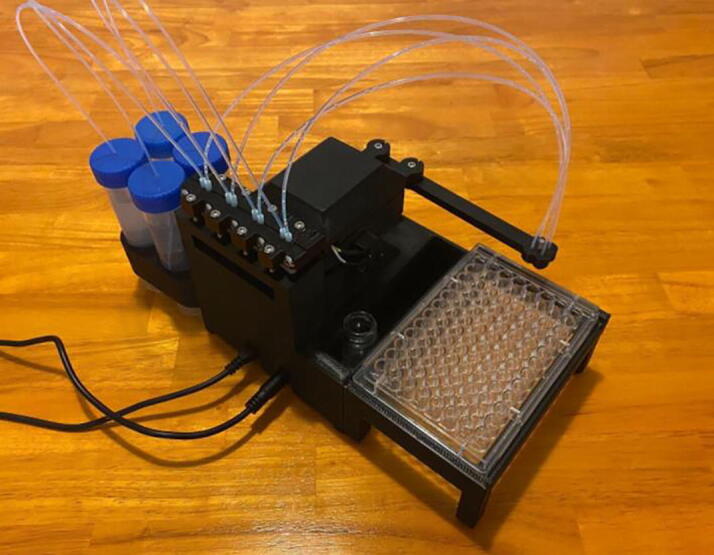
Source: Sidekick: A Low-Cost Open-Source 3D-printed liquid dispensing robot. HardwareX (2022). Original Figure 1. Unmodified publication figure. CC BY 4.0.
The Sidekick system illustrates how accessible engineering can support selected laboratory operations without requiring a complete robotic laboratory. Its capabilities are focused on liquid dispensing rather than general-purpose aspiration and transfer.
This distinction is important because different automated systems address different experimental requirements.
| Technology | Main capability | Representative application |
|---|---|---|
| Manual micropipette | Flexible individual liquid transfers | Small-scale experimentation |
| Multichannel pipette | Simultaneous liquid handling across multiple positions | Microplate-based assays |
| Automated dispenser | Programmed liquid distribution | Repeated reagent addition |
| Robotic liquid handler | Coordinated liquid manipulation | High-throughput sample processing |
| Integrated robotic workstation | Coordination of multiple instruments | Complex experimental workflows |
Table 1. Representative liquid handling technologies and their complementary experimental applications.
The transition from individual liquid handling operations to coordinated automated workflows has contributed directly to the development of high-throughput experimentation.
4. High-Throughput Experimentation and the Expansion of Scientific Scale
Scientific research frequently involves comparing multiple biological or chemical conditions. Researchers may investigate different molecular candidates, environmental variables, sample characteristics or experimental treatments.
As the number of experimental combinations increases, conducting every investigation independently becomes increasingly time-consuming.
High-throughput experimentation addresses this challenge by organizing multiple experimental conditions into parallel or coordinated analytical workflows.
Microplate technologies have become particularly important within this framework. They provide standardized arrangements of individual experimental compartments that can be processed using compatible liquid handling systems, incubators and analytical instruments.
High-throughput screening can help researchers identify experimental candidates associated with measurable biological or chemical characteristics.
A larger experimental scale is valuable when it allows researchers to ask more informative scientific questions.
A microplate-based enzyme activity study may compare several candidate compounds alongside reference conditions and controls. Parallel measurements can help identify differences that warrant additional molecular investigation.
Nevertheless, screening results represent an initial level of experimental evidence. A measured signal may be affected by analytical interference, sample characteristics or limitations of the detection method.
Promising observations generally require confirmation through independent experimental approaches and additional characterization.
The scientific significance of high-throughput research therefore depends on experimental design, appropriate replication, analytical quality and the relevance of the selected measurements.
Managing these increasingly extensive experiments requires more than automated instruments. It also requires computational systems capable of coordinating experimental operations.
5. Laboratory Robotics and Integrated Experimental Systems
Laboratory robotics extends automation beyond individual analytical instruments by introducing systems capable of coordinating physical operations across different experimental devices.
Robotic systems may transport laboratory vessels, interact with automated instrumentation and perform selected operations within programmed experimental environments.
The integration of different instruments is scientifically important because many experiments involve multiple sequential operations. Sample preparation may be followed by incubation, analytical measurement and subsequent data processing.
Without coordination between instruments, researchers must manually transfer samples and manage the timing of individual operations. Integrated laboratory systems can reduce some of these intermediate manual requirements.
Software plays an essential role in this integration. It determines how instruments communicate, how experimental operations are scheduled and how the system responds to interruptions or unexpected conditions.
Research published in Molecular Systems Biology in 2021 introduced Pyhamilton, an open-source software platform supporting flexible programming and coordination of automated liquid handling systems with laboratory instrumentation.
Source: Enabling high-throughput biology with flexible open-source automation. Molecular Systems Biology (2021), original Figure 1. CC BY 4.0.
Integrated automation introduces opportunities to conduct experiments that require extensive coordination between measurements and physical operations.
However, integration also creates additional technical requirements. Instrument compatibility, software reliability, sample identification and error recovery must be considered when developing automated workflows.
As laboratory operations become increasingly connected, the management of experimental information becomes as important as the management of physical samples.
6. Digital Laboratories, Electronic Records and Scientific Data Management
Scientific experimentation generates many forms of information, including sample identities, experimental conditions, instrument measurements, analytical results and observations recorded by researchers.
Traditional laboratory documentation frequently relied on handwritten notebooks and manually organized records. These approaches remain useful but may become difficult to manage when experiments generate extensive datasets or involve multiple instruments and researchers.
Laboratory digitalization introduces information systems that support the organization, documentation and retrieval of experimental knowledge.
Electronic laboratory notebooks, commonly abbreviated as ELNs, provide digital environments for recording experimental procedures, observations and scientific interpretations.
Laboratory information management systems, or LIMS, focus on the structured management of samples, analytical workflows, associated measurements and laboratory records.
Scientific data management systems can provide additional capabilities for organizing experimental files, instrument-generated information and associated metadata.
| Digital laboratory system | Primary purpose | Scientific contribution |
|---|---|---|
| ELN | Experimental documentation | Preservation of methods and research observations |
| LIMS | Sample and workflow management | Sample traceability and structured laboratory operations |
| Scientific data management system | Organization of scientific files and metadata | Data retrieval and preservation |
| Laboratory execution system | Guidance and recording of experimental procedures | Workflow consistency and procedural documentation |
| Instrument control software | Management of instrument operations | Coordinated acquisition of experimental measurements |
Table 2. Complementary information systems supporting modern digital laboratories. Capabilities may overlap between individual platforms.
For example, a digital research workflow may associate a biological sample with its origin, storage history, experimental treatment and analytical measurements.
This association helps researchers investigate whether unexpected results are related to biological characteristics, experimental conditions or technical variation.
Digital records also provide a foundation for computational analysis by organizing scientific information into formats that can be processed and evaluated systematically.
The integration of reliable experimental information with computational decision-making has encouraged the development of intelligent laboratory systems.
7. Artificial Intelligence and the Emergence of Intelligent Experimentation
Conventional laboratory automation typically performs operations according to predefined instructions. The experimental conditions are selected by researchers, and instruments execute the corresponding procedures.
Artificial intelligence introduces additional possibilities by supporting the interpretation of experimental information and assisting in the selection of subsequent research conditions.
Machine learning models can identify patterns within experimental datasets, estimate relationships between variables and help researchers investigate complex experimental spaces.
An important application involves experimental optimization. Instead of evaluating every possible combination of variables, computational approaches can help prioritize conditions expected to provide informative measurements.
Bayesian optimization is one approach used in this context. It uses a probabilistic representation of relationships between experimental variables and measured outcomes to guide the selection of further experiments.
Scientific objective
Define the research question and relevant measurements.
Experimental planning
Identify potentially informative experimental conditions.
Automated investigation
Execute experiments and collect scientific measurements.
Computational learning
Evaluate observations and inform further investigation.
↻ An iterative relationship between scientific questions, experimental evidence and computational decision-making.
The quality of intelligent experimentation depends on the relevance of the selected research objective and the reliability of the measured information.
An algorithm may successfully optimize a numerical measurement without improving the biological or chemical characteristic that researchers originally intended to investigate.
Scientific expertise is therefore necessary to establish meaningful objectives, identify experimental limitations and evaluate whether computational recommendations are scientifically appropriate.
When automated experimental systems and computational decision-making operate within a coordinated feedback loop, they form the foundation of self-driving laboratories.
8. Self-Driving Laboratories and Autonomous Scientific Discovery
Self-driving laboratories integrate experimental automation, analytical instrumentation and computational decision-making within systems designed to conduct iterative scientific investigations.
Their distinguishing characteristic is the ability to use experimental observations to inform subsequent experimental choices within a defined research framework.
This approach differs from conventional automation because the sequence of experimental conditions is not necessarily established entirely before experimentation begins.
Instead, a computational system may update its representation of the experimental problem as new measurements become available.
In 2026, Pilon and colleagues described RoboChem-Flex, a modular self-driving laboratory developed to investigate chemical reaction optimization while addressing barriers associated with cost, technical complexity and laboratory accessibility.
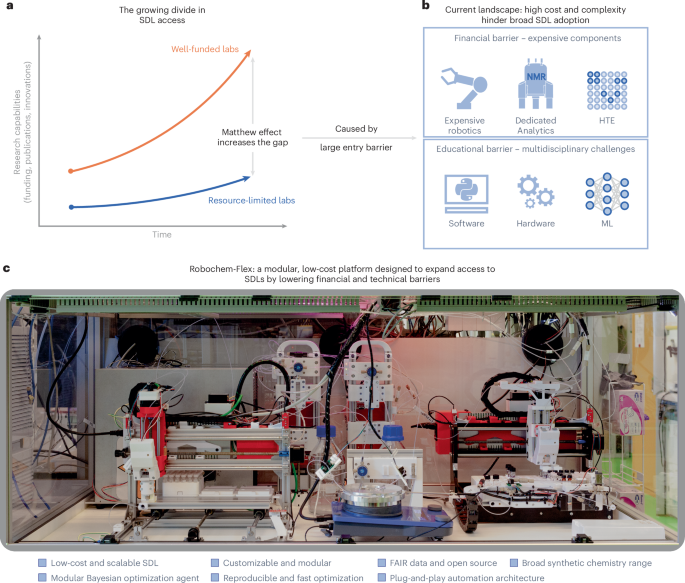
Source: Pilon S, Savino E, Bayley OM, et al. A flexible and affordable self-driving laboratory for automated reaction optimization. Nature Synthesis, 5, 1552–1564 (2026). Original Figure 1. Unmodified publication figure. CC BY 4.0.
The significance of modular autonomous laboratories extends beyond the development of individual instruments. Modular designs can facilitate the integration of different experimental and analytical capabilities according to specific research requirements.
Nevertheless, laboratory autonomy exists within defined boundaries. Researchers remain responsible for scientific objectives, experimental constraints, safety requirements and the interpretation of research outcomes.
| Laboratory model | Experimental execution | Decision-making |
|---|---|---|
| Manual laboratory | Primarily researcher-operated | Human-directed |
| Automated laboratory | Programmed instrumental operations | Predefined experimental instructions |
| Integrated digital laboratory | Coordinated instruments and information systems | Human decisions supported by digital information |
| AI-assisted laboratory | Manual or automated experimentation | Computational recommendations with human oversight |
| Self-driving laboratory | Coordinated automated experimentation | Feedback-based selection within defined research constraints |
Table 3. Conceptual comparison of laboratory operating models according to experimental execution and decision-making capabilities.
Self-driving laboratories represent an evolving research framework rather than a replacement for scientific reasoning. Their scientific value depends on the quality of the experiments they perform and the knowledge those experiments help generate.
9. Experimental Reproducibility, Quality Control and the Human Role
One important objective of laboratory automation is to improve the consistency of experimental operations. Programmed instruments can help reduce variation associated with repeated manual procedures.
However, consistency is not equivalent to scientific correctness. An automated system may reproduce an unsuitable experimental procedure or repeatedly generate measurements affected by systematic analytical error.
Quality control remains essential throughout automated research workflows. Instruments must be maintained and evaluated according to their intended applications, while experimental materials and analytical procedures require appropriate characterization.
Sample traceability is particularly important when multiple instruments and information systems operate within the same laboratory. Researchers must be able to establish the relationship between a biological sample, its processing history and the resulting measurements.
Software reliability introduces another dimension of laboratory quality. Changes in control software, analytical algorithms or instrument configurations may influence experimental outcomes.
Appropriate calibration, maintenance and performance assessment of laboratory equipment.
Characterized biological materials, reagents and compatible laboratory consumables.
Documented experimental operations, software configurations and associated scientific data.
Critical evaluation of experimental design, unexpected observations and research conclusions.
Human expertise remains particularly important when experimental observations differ from computational expectations.
Unexpected results may reveal instrument problems, unsuitable assumptions or genuinely interesting biological phenomena. Distinguishing between these possibilities requires scientific reasoning and contextual understanding.
The development of automated laboratories therefore changes the distribution of experimental responsibilities rather than eliminating the role of researchers.
Scientists increasingly combine disciplinary knowledge with expertise in instrumentation, experimental design, data interpretation and computational methods.
This multidisciplinary relationship provides the foundation for the next generation of biotechnology research.
10. The Future of Laboratory Science and Intelligent Biotechnology
The evolution of laboratory research reflects a continuous relationship between scientific questions and technological capabilities.
Manual experimentation established the foundations of controlled scientific investigation. Precision instrumentation expanded measurement capabilities, while automated liquid handling and robotic technologies introduced new opportunities for coordinated experimental operations.
Digital laboratory systems strengthened the organization of research information, and artificial intelligence introduced additional approaches for interpreting experimental observations and supporting research decisions.
The convergence of these technologies is particularly relevant to biotechnology, where experimental investigations frequently involve relationships between biological materials, molecular processes and complex analytical measurements.
A study published in Scientific Reports in 2025 illustrates how automated experimental platforms and computational optimization can be combined to investigate biological production processes. The research connects experimental measurements with successive computationally informed investigations.
Scientific reference: Fushimi K, et al. Development of the autonomous lab system to support biotechnology research. Scientific Reports (2025).
Future biotechnology laboratories may increasingly integrate automated sample processing, advanced biological models, molecular assays, digital experimental records and computational analysis within interconnected research frameworks.
| Laboratory technology | Scientific contribution | Biotechnology connection |
|---|---|---|
| Precision instrumentation | Reliable analytical measurements | Molecular and cellular characterization |
| Liquid handling automation | Consistent experimental operations | Assay development and sample processing |
| High-throughput systems | Parallel scientific investigation | Biological and molecular screening |
| Laboratory robotics | Coordination of experimental instruments | Integrated biological workflows |
| Digital laboratory systems | Experimental documentation and traceability | Research quality and data management |
| Artificial intelligence | Computational interpretation and experimental planning | Intelligent biotechnology development |
Table 4. Connections between modern laboratory technologies and biotechnology research applications.
The development of these systems also creates new requirements for scientific research materials. Automated instruments depend on compatible consumables, well-characterized reagents, reliable analytical technologies and standardized experimental resources.
Laboratory innovation will therefore continue to involve collaboration between scientists, instrument developers, software engineers, biotechnology researchers and scientific material manufacturers.
The most important measure of technological progress will not simply be the number of automated operations performed, but the ability of integrated research systems to generate meaningful, reproducible and scientifically valuable evidence.
The laboratory of the future is not defined by the absence of human intervention, but by the intelligent connection between scientific reasoning, experimental technology and reliable evidence.
By integrating precision instrumentation, laboratory robotics, digital information and computational intelligence, modern biotechnology is expanding the possibilities for experimental discovery. These developments continue the fundamental scientific tradition of transforming meaningful questions into knowledge through observation, experimentation and critical evaluation.