Single-Cell Technologies: Understanding Biological Complexity
Explore how single-cell sequencing, cellular profiling and single-cell multi-omics reveal biological heterogeneity, cellular identity and the molecular mechanisms underlying health and disease.
Every living tissue is composed of cells that differ in their molecular characteristics, biological functions and responses to environmental conditions. Although many cells within an organism share essentially the same genetic information, they can develop remarkably different identities and functional properties. Understanding this diversity represents one of the central challenges of modern biological research.
For decades, molecular technologies primarily examined biological samples by combining information from large populations of cells. These approaches established essential foundations for genetics, molecular biology and biotechnology, but they frequently concealed differences between individual cells.
Single-cell technologies introduce a fundamentally different perspective. By examining molecular information at individual-cell resolution, researchers can investigate cellular identity, developmental transitions, biological heterogeneity and disease-associated changes with unprecedented detail.
1. Cellular Diversity: The Biological Complexity Hidden Within Tissues
The cell represents a fundamental organizational unit of living organisms. In multicellular organisms, specialized cellular populations perform complementary functions that collectively maintain tissue organization and physiological activity.
Neurons transmit electrical and chemical signals, muscle cells generate mechanical forces, epithelial cells establish protective interfaces and immune cells participate in biological defense. These differences arise through coordinated processes of gene regulation, cellular differentiation and interactions with the surrounding environment.
However, cellular diversity extends beyond these well-established categories. Cells belonging to the same general population may exhibit different developmental states, metabolic characteristics or responses to external signals.
For example, immune cells classified as T lymphocytes can differ in their activation status, differentiation history and functional characteristics. Some participate in immediate immune responses, while others contribute to immunological memory or the regulation of immune activity.
When these populations are analyzed collectively, their molecular measurements may provide an averaged representation that obscures biologically important differences.
A biological population is not necessarily uniform. Understanding its behavior requires investigating both its overall molecular characteristics and the diversity of the individual cells from which it is composed.
This recognition has encouraged the development of analytical technologies capable of investigating biological information without losing individual cellular identity.
2. From Population-Level Measurements to Individual-Cell Analysis
Conventional molecular analysis frequently involves extracting DNA, RNA or proteins from biological samples containing many cells. The resulting measurements describe the combined molecular characteristics of those populations.
Bulk RNA sequencing, for instance, provides valuable information about gene expression within a biological sample. However, an observed difference in gene expression between two samples may arise through several distinct biological mechanisms.
Individual cells may have changed their expression of a particular gene, or the relative abundance of different cellular populations may have changed. Both processes can influence the overall molecular measurement.
5 + 5 + 5 + 5
Average expression: 5 units
A population containing cells with similar expression levels.
1 + 1 + 9 + 9
Average expression: 5 units
A heterogeneous population containing cells with low and high expression levels.
Illustrative numerical example using hypothetical expression values. Both populations have the same average but different cellular distributions. Not experimental data.
Single-cell analysis helps distinguish between these possibilities by associating molecular measurements with individual cells.
This analytical resolution allows researchers to investigate whether a biological response occurs uniformly across a population or is associated with particular cellular subsets.
| Characteristic | Bulk molecular analysis | Single-cell analysis |
|---|---|---|
| Analytical unit | Combined biological sample | Individual cell |
| Cellular heterogeneity | Indirectly inferred | Directly investigated at the measured molecular level |
| Rare cell populations | Signals may be diluted | Potentially identifiable when adequately sampled |
| Data complexity | Generally lower | High-dimensional cellular profiles |
| Representative application | Overall molecular differences between samples | Cell-specific expression and cellular composition |
Table 1. Complementary characteristics of bulk and single-cell molecular profiling approaches.
Both analytical strategies remain scientifically valuable. Bulk measurements may provide robust population-level information, while single-cell technologies offer additional insight into the cellular sources of those measurements.
Among single-cell technologies, RNA sequencing has become particularly important because gene expression patterns provide information about the molecular programs associated with cellular identity and biological state.
3. Single-Cell RNA Sequencing and the Molecular Identity of Cells
Gene expression is a central component of cellular function. Through transcription, genetic information encoded within DNA contributes to the production of RNA molecules involved in protein synthesis, molecular regulation and other biological processes.
Different cell types express different combinations of genes. These expression patterns can provide information about cellular specialization, developmental characteristics and responses to biological conditions.
Single-cell RNA sequencing, commonly abbreviated as scRNA-seq, examines RNA expression profiles while retaining information about the individual cells from which the measured molecules originate.
Modern platforms frequently use molecular barcodes to associate sequencing information with individual cells. Barcoding allows material originating from many cells to be analyzed collectively while preserving their individual molecular identities.
The resulting dataset commonly takes the form of a matrix in which individual cells are associated with measurements of detected gene expression. Computational methods subsequently help researchers explore similarities and differences between cellular profiles.
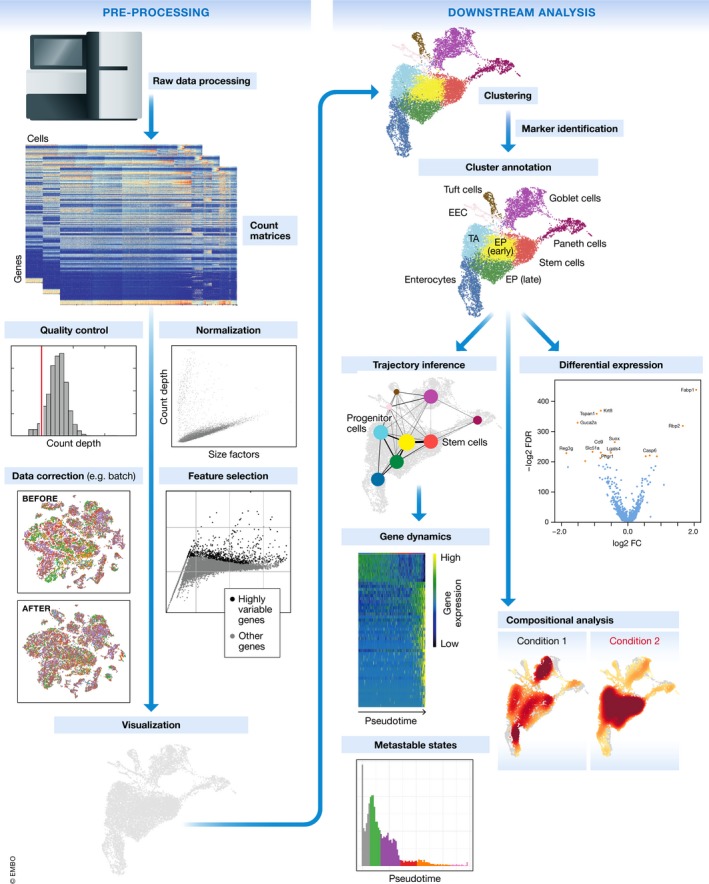
Source: Luecken MD and Theis FJ. Current best practices in single-cell RNA-seq analysis: a tutorial. Molecular Systems Biology, 15, e8746 (2019). Original Figure 1. Reproduced without modification under CC BY 4.0.
Single-cell transcriptomics can reveal expression patterns associated with specialized cellular populations that might remain difficult to distinguish through conventional molecular analysis.
Nevertheless, an RNA expression profile represents only one dimension of cellular biology. Protein abundance, molecular interactions, chromatin organization and metabolic processes contribute additional information about cellular function.
This limitation has encouraged the development of single-cell technologies capable of investigating different molecular characteristics beyond RNA expression alone.
4. Beyond RNA: Single-Cell Genomics, Epigenomics and Proteomics
The molecular identity of a cell emerges from interactions between genetic information, regulatory mechanisms, proteins and biochemical processes. A comprehensive understanding of cellular behavior therefore requires consideration of several complementary molecular dimensions.
Single-cell genomics investigates genetic information within individual cells. This approach can help researchers examine genetic heterogeneity, including differences in chromosome copy number and selected genomic alterations.
Such information is particularly relevant in cancer biology, where distinct cellular populations within a tumor may possess different genetic characteristics.
Single-cell epigenomics investigates molecular features associated with the regulation of genetic information. Chromatin accessibility, for example, provides information about genomic regions that may be available for interactions with regulatory proteins.
Single-cell ATAC sequencing, commonly abbreviated as scATAC-seq, is one approach used to investigate chromatin accessibility. Its measurements can help researchers examine regulatory differences between cellular populations, although accessible chromatin does not independently establish gene expression or regulatory activity.
Single-cell proteomics provides complementary information about proteins. Flow cytometry, mass cytometry, antibody-based sequencing approaches and emerging mass spectrometry methods can examine different aspects of protein composition at cellular resolution.
| Technology | Molecular information | Scientific contribution | Important limitation |
|---|---|---|---|
| Single-cell DNA sequencing | Genetic sequences and genomic variation | Investigation of cellular genetic differences | Incomplete coverage and amplification-associated bias |
| scRNA-seq | RNA expression | Cell identity and transcriptional state | Incomplete transcript detection |
| scATAC-seq | Chromatin accessibility | Investigation of gene regulatory landscapes | Sparse measurements and indirect regulatory inference |
| Flow cytometry | Selected molecular markers and physical properties | Cellular identification and phenotyping | Panel-dependent molecular coverage |
| Single-cell proteomics | Detectable cellular proteins | Protein-level cellular characterization | Platform-dependent sensitivity and coverage |
Table 2. Complementary molecular perspectives provided by representative single-cell technologies.
The scientific importance of these approaches lies in their ability to investigate different components of cellular biology.
For example, two cells may have similar RNA expression profiles while exhibiting different levels of particular surface proteins. These differences can influence how the cells interact with their environment or respond to external signals.
Integrating complementary molecular measurements therefore creates opportunities to develop more informative descriptions of cellular identity and biological function.
5. Single-Cell Multi-Omics: Integrating Molecular Dimensions
Single-cell multi-omics seeks to connect different types of molecular information within a common cellular framework. Depending on the analytical technology, researchers may examine RNA expression together with selected proteins, chromatin accessibility or other molecular characteristics.
This integration is important because relationships between molecular dimensions are not always straightforward. RNA expression does not necessarily correspond directly to protein abundance, and chromatin accessibility does not guarantee transcriptional activity.
CITE-seq is an example of a technology that combines RNA profiling with measurements of selected proteins through antibodies carrying oligonucleotide identifiers.
By connecting transcriptomic and protein information, researchers can investigate cellular characteristics that may be difficult to distinguish when either molecular dimension is examined independently.
In a study published in Cell in 2021, Hao and colleagues demonstrated a computational approach for integrating complementary single-cell measurements into a shared representation of cellular identity.
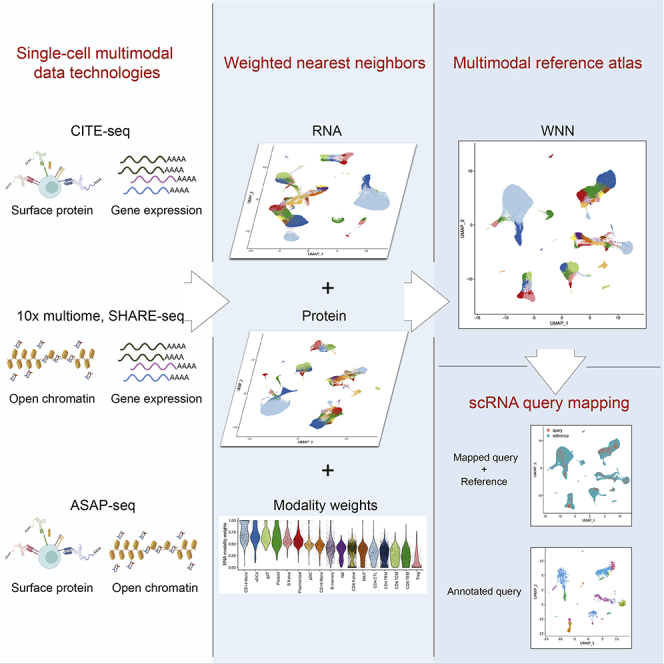
Source: Hao Y, et al. Integrated analysis of multimodal single-cell data. Cell, 184, 3573–3587.e29 (2021). Original graphical abstract. Reproduced without modification under CC BY 4.0.
A representative application involves immune cell characterization. Measurements of selected surface proteins can help distinguish cellular subsets whose transcriptional profiles are relatively similar.
Conversely, RNA expression measurements may provide information about cellular characteristics that are not represented within a predefined antibody panel.
Integrating both perspectives can therefore support a more detailed investigation of cellular diversity.
The development of these technologies also creates opportunities to examine how cellular identity changes over time, particularly during development and differentiation.
6. Cellular Differentiation and the Reconstruction of Biological Transitions
Multicellular organisms develop through coordinated processes in which cells acquire increasingly specialized characteristics. Stem and progenitor cells can give rise to differentiated populations, contributing to tissue formation, renewal and repair.
Understanding differentiation requires investigating how molecular characteristics change as cells transition between biological states.
Traditional experimental approaches can examine cells collected at different developmental stages. However, biological differentiation does not always occur synchronously across a cellular population.
Single-cell analysis provides opportunities to investigate cells exhibiting different degrees of differentiation within the same biological sample.
Computational trajectory inference uses relationships between cellular molecular profiles to construct representations of possible biological transitions.
Pseudotime is a computational ordering that describes the relative progression of cells along an inferred biological process. It does not necessarily correspond to measured chronological time.
Conceptual representation of branching cellular differentiation. The positions and trajectories are illustrative and do not represent experimental data.
Hematopoiesis provides a useful biological example. Blood-forming stem and progenitor cells contribute to the production of different blood cell populations through coordinated differentiation processes.
Single-cell molecular profiles can help researchers investigate intermediate states associated with these developmental transitions.
Nevertheless, computational trajectories represent hypotheses about relationships between cells. They do not independently demonstrate that one observed cell population develops directly into another.
Experimental lineage tracing, longitudinal measurements and functional characterization provide complementary approaches for evaluating these relationships.
The ability to investigate developmental states has important implications for disease research, where normal differentiation processes and cellular regulation may become altered.
7. Single-Cell Technologies in Cancer, Immunology and Disease Research
Disease mechanisms frequently involve changes within particular cellular populations rather than uniform alterations across entire tissues. Single-cell technologies allow these changes to be investigated with greater cellular specificity.
Cancer provides a particularly important example of biological heterogeneity. Tumors can contain malignant cells with different molecular characteristics together with immune cells, fibroblasts, endothelial cells and other components of the surrounding microenvironment.
Differences between malignant cell populations may be associated with genetic variation, cellular differentiation, metabolic characteristics or responses to environmental conditions.
Single-cell analysis can help identify molecular states associated with these differences and provide hypotheses concerning tumor progression or responses to experimental treatments.
In immunology, single-cell technologies allow researchers to investigate the composition of immune populations and changes associated with activation, differentiation and disease.
For example, an immune response may involve the expansion of particular lymphocyte populations together with changes in their expression of regulatory or functional molecules.
A disease-associated molecular signal may originate from a specific cellular population rather than from every cell within the affected tissue.
Identifying the cellular source of molecular changes can help researchers develop more focused hypotheses about disease mechanisms and potential experimental targets.
Neuroscience represents another important application. The nervous system contains diverse neuronal and non-neuronal populations, with molecular characteristics that vary according to developmental history, anatomical organization and physiological state.
Single-cell and single-nucleus approaches can contribute to the investigation of these populations, including molecular changes associated with neurological disorders.
However, observed disease-associated expression patterns may represent a cause, consequence or accompanying feature of a biological process. Additional experiments are necessary to establish their mechanistic significance.
Interpreting disease-associated cellular changes also requires reliable knowledge of the diversity present within biological reference populations. This requirement has motivated the development of large-scale cellular atlases.
8. Human Cell Atlases and the Molecular Mapping of Biological Systems
A cellular atlas is a reference resource that organizes information about cellular populations within tissues, organs or broader biological systems.
Traditional anatomical research established descriptions of organs based on their physical structures and specialized functions. Single-cell technologies provide an additional molecular dimension to these descriptions.
By integrating cellular profiles from different biological samples, researchers can investigate common molecular characteristics, cellular diversity and variation between individuals.
The Human Cell Atlas initiative reflects this scientific ambition by encouraging the development of reference resources that characterize human cellular diversity.
An important example is the integrated Human Lung Cell Atlas described by Sikkema and colleagues in Nature Medicine in 2023.
The study combined 49 datasets encompassing more than 2.4 million cells from 486 individuals. This integrated resource supports the comparison of cellular characteristics across different studies and biological conditions.

Source: Sikkema L, et al. An integrated cell atlas of the lung in health and disease. Nature Medicine, 29, 1563–1577 (2023). Original Figure 3. Unmodified publication figure. CC BY 4.0.
Reference atlases can help researchers compare newly generated cellular datasets with previously characterized biological populations.
They may also support the identification of uncommon cellular populations and the investigation of molecular states shared across different biological conditions.
Nevertheless, an atlas is not a complete or permanently fixed description of human biology. Its coverage depends on the included individuals, tissue sampling, analytical technologies and computational methods.
Furthermore, cellular reference maps constructed from dissociated tissues may not fully preserve the original physical organization of cells. Spatial omics provides complementary information by reconnecting cellular identity with tissue location.
The integration of these technologies illustrates how increasingly detailed biological measurements create new opportunities while introducing additional requirements for analytical reliability.
9. Bioinformatics, Experimental Limitations and Scientific Reliability
Single-cell technologies generate complex datasets containing molecular measurements for large numbers of individual cells. Computational analysis is therefore an essential component of their scientific interpretation.
Quality assessment helps researchers identify molecular profiles affected by technical limitations. These limitations may include low molecular detection, cellular damage, contamination from extracellular RNA or the simultaneous capture of multiple cells.
Computational clustering groups cells according to similarities in their measured characteristics. Dimensionality reduction methods, including UMAP and t-SNE, help visualize relationships within high-dimensional molecular datasets.
However, visual proximity within a computational representation does not necessarily correspond to physical proximity within a tissue. Likewise, a computationally identified cluster does not automatically establish a distinct biological cell type.
| Analytical challenge | Potential consequence | Scientific consideration |
|---|---|---|
| Incomplete molecular detection | Missing expression signals | Distinguish non-detection from biological absence |
| Doublets and multiplets | Combined profiles from multiple cells | Evaluate potentially mixed cellular identities |
| Ambient RNA | Signals originating outside the measured cell | Consider sample-associated contamination |
| Batch effects | Technical differences between experiments | Separate technical variation from biological variation |
| Sampling bias | Underrepresentation of particular cell populations | Consider tissue processing and cellular recovery |
| Pseudoreplication | Overestimated statistical confidence | Account for independent biological samples |
Table 3. Important experimental and computational considerations in single-cell molecular research.
An especially important consideration concerns biological replication. Thousands of cells collected from a single individual do not represent thousands of independent individuals.
When researchers compare biological conditions, the experimental design and statistical analysis must account for the relationships between cells and their original biological samples.
The reliability of single-cell findings also benefits from complementary evidence. Protein measurements, microscopy, functional assays and independent biological samples can help evaluate the significance of computational observations.
Scientific discovery therefore depends not simply on generating detailed cellular measurements, but on determining which observations represent meaningful and reproducible biological characteristics.
10. From Cellular Resolution to the Future of Modern Biotechnology
Single-cell technologies have introduced a new perspective on the organization and behavior of living systems. By connecting molecular information with individual cellular identities, they allow researchers to investigate biological relationships that may remain concealed within population-level measurements.
These capabilities are particularly relevant to modern biotechnology, where understanding cellular characteristics can contribute to the development of biological models, analytical technologies and experimental research tools.
In regenerative medicine research, single-cell analysis can help characterize stem cell-derived populations and investigate the molecular characteristics associated with cellular differentiation.
In organoid research, cellular profiling can contribute to the assessment of biological diversity within three-dimensional experimental models. Comparisons with reference tissues can help researchers investigate which cellular populations and molecular characteristics are represented within those models.
Biopharmaceutical research may also benefit from more detailed characterization of cellular populations. Differences in gene expression, cellular state and molecular regulation can provide insights into the biological characteristics associated with experimental production systems.
Cellular profiling
Investigate individual molecular characteristics.
Biological discovery
Identify cellular states and potential relationships.
Experimental validation
Evaluate biological relevance through complementary evidence.
Biotechnology
Apply validated knowledge to scientific tools and research systems.
Conceptual progression connecting cellular measurements with scientific discovery and biotechnology development.
Future research will increasingly investigate how single-cell molecular information can be combined with spatial biology, advanced imaging, computational modeling and functional experimental systems.
Such integration may help connect cellular identity with tissue organization, developmental history and measurable biological function.
The development of these approaches also depends on reliable laboratory resources, including molecular reagents, antibodies, cellular analysis instruments, sequencing technologies and standardized biological materials.
Together, these scientific resources support the transformation of complex molecular measurements into knowledge that can inform future experimental investigation.
To understand the complexity of life, we must recognize the individuality of the cells that create it.
Single-cell technologies connect fundamental cellular biology with modern molecular analysis and biotechnology. By revealing biological diversity and supporting the investigation of cellular relationships, they provide new opportunities for scientific discovery. Their greatest value emerges when detailed molecular observations are integrated with reliable experimental evidence and meaningful biological questions.